Showing posts with label medicine. Show all posts

April 12, 2015

medicine | in the dark

For the past now 3 weeks, despite the days getting longer and more beautiful, my work day has me up and at the hospital before sunrise and leaving after the sun sets.   I feel like I live my life now in a timeless, dayless always-night.

Whenever this happens, I always worry it will never end because it's so soul-sucking.  But in a mere 5 days I'll have a day off and get to run around in the sunshine. 

I thought I might share some strategies I'm trying to develop for coping - for when this happens to me again or if you find yourself at a time like this.

First, remembering why I'm doing this. I love being an OB-Gyn and when I'm at work, actively helping women, I feel good.  

Second, carve out time to move. One of the hardest things about getting home in the dark is that I don't have a great, safe, dark running route from my house. Running is and has been for a long time, the way I de-stress and cope with feeling trapped inside a hospital all day.  I may just buy some pepper spray and run laps on the main road.  I'm getting a bit desperate.  But I've also started doing some yoga podcasts in my call room, which helps.  

Third, feel the breeze, look at the outside, even if you can't be there. I try to find windows and open them whenever possible. It reduces the feeling that there is no changing of time. Especially these days when everything is so pretty! 

Fourth, eat well. Nothing like feeling trapped and I'll. I'm not always the best at this, but I try even harder when I'm in one of these long stretches of work to make sure I'm getting enough fruit, veggies, protein, and water.  Water is huge.  

Fifth and finally, remember that it won't last forever. The body (and mind) are pretty resilient and can recover from a short hard stint like this.  I'm dreaming of my long run next Saturday followed by a spa day to celebrate my sister's upcoming wedding.  

In the meantime. I'm hanging out in darkness.  

February 7, 2015

medicine | robots


my days are filled with robots.

no, really.  I started by gyn oncology rotation - which is part of why I haven't blogged in a while.  4am starts and the operating room all day leave very little energy or time for blogging.

but back to the robots.
robotic surgery is a (semi) new technology that has been embraced by gynecologists.  It is similar to laparoscopic surgery in that the instruments enter the abdomen through small holes and ports on the abdomen.  
In laparoscopy, however, the instruments are held and manipulated by human hands, like this:


In robotic surgery, the surgeon sits at a console just next to the patient, and the instruments are held in place and actually manipulated by robotic arms, like this:

(the patient is under the blue sheet)

the research is still mixed on whether the robot is actually cost-effective for the patient and for our system (meaning the super expensive cost of the  machine as well as the additional people required to run an operating room with robotic surgery translates to improved outcomes, shorter hospital stays, shorter recover times, etc), but from a surgeon point of view, it's an amazing way to operate.  

as I get farther into my ob-gyn residency, I'm thinking more about what I want to do when I finish residency, as the options in Ob-Gyn are very diverse.  this month at least, I love operating and think that offering my patients minimally invasive surgeries would be an amazing skill in my tool box.

PS: if you're interested in seeing a robotic hysterectomy video (not for the faint of heart), 
here's an awesome one here that is only 18 minutes (!!) long


July 19, 2014

medicine | DOS

you gotta be bad/ you gotta be bold/ you gotta be wiser
you gotta be hard/ you gotta be tough/ you gotta be stronger
you gotta be cool/ you gotta be calm/ you gotta stay together
all I know all I know is love will save the day

(lyrics from des'ree, you gotta be)

...and somehow I became a second year.

June 13, 2014

lessons from intern year


I finished my intern year!  What a wild, exciting, crazy, tough, heart-wrenching, and did I mention CRAZY year it's been.  I finally understand the "drinking from a fire hose" learning metaphor because I've basically been blasted in the face by the knowledge fire hose 24/7 for the past 525,600 minutes.

To try to synthesize all that down to just a few lessons is obviously difficult - so without giving you a lecture about postpartum hemorrhage or laparoscopy post-operative complications (all of which I finally know something about), here are some of the life lessons I've learned this year that I think (hope) will help me survive the next three.

September 14, 2013

Autumn Reading List


one of my dreams since moving to DC has been to join a book club.  it seems like everyone is in them here.  I want to be one of the people who meets up with brilliant, clever, funny people to discuss how a book made them think, feel, wonder differently about the world.  I'm in the process of scouting a few book club options, but in the meantime, here's my personal fall reading list:

1. When Everything Changed by Gail Collins
a nonfiction account about the truth, myths and mystery in the US women's revolution

2. The Fault in Our Stars by John Green
nonfiction account of a 16yo with terminal cancer who is just. so. freaking. hilarious and profound

3. A Suitable Boy by Vikram Seth
a full immersion story about relationships and life in India

4. Expecting Better by Emily Oster
a chicago economist takes on the data about pregnancy recommendations

5. Complications: A Surgeon's Notes on an Imperfect Science by Atul Gawande (a  re-read)
a book about how medicine is human

6. The Collected Work of Nikki Giovanni by Nikki Giovanni
a book of poetry by one of the most wonderful modern poets

7. A Spiritual Guide to Midwifery by Ida May Glass
a nonfiction account of Ida May's midwifery practice from beginning to present day

8. A Practical Wedding by Meg Keene
because, you know, I'm planning a wedding but don't want to be a crazy, silly bride

9. Let's Explore Diabetes with Owls by David Sedaris
my official book club book and one of the FUNNIEST authors ever. I'm so excited

10. The Guernesy Literary and Potato Peel Pie Society by Mary Ann Shaffer
recommended by several friends, entirely of letters during WW2

what's on your reading list?  what should I add to mine?
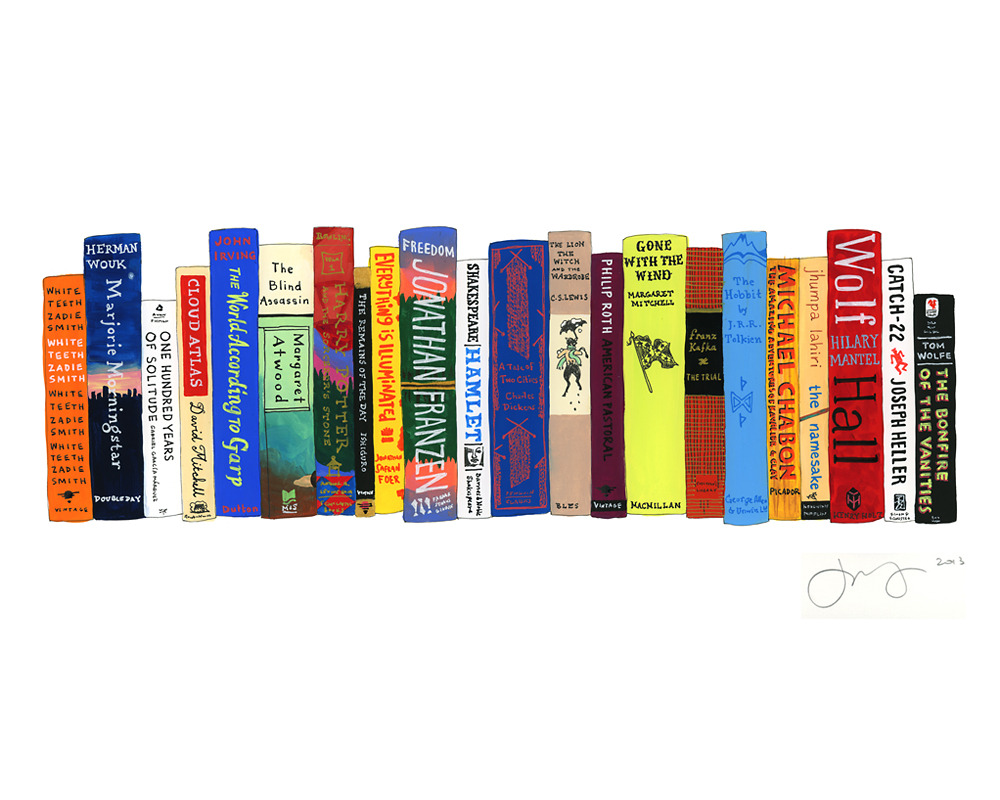
Also, I love the paintings of people's bookshelves in Jane Mount's book - I keep thinking about what would be on my idea bookshelf.  Maybe at some point I'll have to actually design one and draw it out.


photo credit: idealbookshelf by Jane Mount

September 11, 2013

two stories: 9/2013

story 1*

After a month in the ICU, I worry I've become cynical.  Not because I don't believe in the power and might of modern medicine but because I worry that we use it too much instead of trying to help people cope with questions of happiness and mortality, quality and quantity of life.  Since my month has started, several patients have died in the ICU, all of them incredibly sick and all of the stories incredibly sad.  It's often a burden to carry the knowledge I've worked so hard to obtain about human physiology and pathology of different disease processes because it's often so much more obvious to me (and to the rest of the medical team) than to the patient's family that the patient - their husband, daughter, wife, brother - is not going to get better.

But this week I'm more optimistic.  I've been talking a lot with the partner of one of my patients, let's call the patient Tom and the partner Pat.  A few days ago (when I'm writing this, not when I'm actually publishing it) Pat was incredibly overwhelmed with grief.  Tom had been intubated for over a week and didn't appear to be getting any better.  Pat was plagued by the big questions that arise whenever a loved one is incapacitated and decisions have to be made by loved ones, including "is this what he would have wanted?"  Tom had come in directly from an ambulance after a motorcycle accident, had fractured his pelvis, arms, and legs, and had suffered multiple abdominal injuries requiring the placement of a feeding tube to give his intestines some time to heal.  He had also been intubated with an endotracheal tube and put on a breathing machine.  Tom had been through multiple surgeries at this point, had been given so much fluid to try to keep his blood pressure high enough to perfuse his brain and other organs that his skin was stretched and puffy.  His bruises that formed after the accident were turning every shade from blue to yellow and gave his skin a patchy appearance.  I talked to Pat most days and updated him about how we were caring for Tom and answered his questions about next steps.  But yesterday, Pat took me aside and just said to me, look.  I just want to know if you think he's going to get better, because I have to tell you, I'm getting discouraged.  Every day it looks like he is in more  pain, is more bloated, and getting worse.  And I totally got it.  Tom DID look horrible in lots of ways - the tubes, the lines, the sedation, the bloating, I tried to make myself see the picture that Pat was seeing so that I could fully understand.  But strangely, after four years of medical school and three months of intern year, everything I know now makes me look at Tom with great optimism; he's the kind of person who truly gets better in an ICU.  He had his reconstructive orthopedic (bone) surgery and it went really well.  The drains in his abdomen were taking care of a lot of the fluid.  His kidney tests looked great.   All of the cultures we had taken showed that he didn't have any infections.  Yes, he was sedated and using the tube to breath, but that wasn't because he necessarily couldn't breathe without it, it's that we we still determining if it could be removed, and were therefore sedating him so that he wasn't (appropriately) agitated by having a tube down his throat.  So I went through all of that - or most of it - with Pat and said, I know it doesn't look like it to you, but Tom really is getting better.  And Pat believed me, and it gave him hope.  I left for home that day thinking that it's these moments when I feel the most privileged, helpful, and just so proud of how hard I have worked to gain this knowledge and the skills to be able to explain them to help people cope.


story 2.

A few weekends ago, on a unique day off together, my husband-of-the-future and I biked to a farmers market in town.  We bought tomatoes, cheese, garlic, and iced coffee, wandered around a bit more checking out all the stalls, and then decided to bike home.  Our bike home took us on a bike path along a busy city street.  We were talking about what we were going to make for dinner when all of a sudden a motorcycle swerved into the intersection just as a taxi cap decided it would try to make the last second of a yellow light and the two collided in a loud crash.  Without pausing for one moment, both Chris and I biked right up to the accident, threw our bikes on the ground and went to the side of the motorcycle rider to assess him.  I'm sure if we had been a movie, the screen would have zoomed in on our minds scanning the scene for dangers, looking at the man to see if he was moving, breathing and if there was blood.  You would have seen us click through the steps of out-of-hospital resuscitation including CPR and rescue breathing.

And there may have been a flashback to another bike ride, in another time, when I didn't know what to do, didn't know how to be responsible for someone being injured, and instead of jumping into action, I froze.

The man turned out to be just fine.  He probably broke his ankle, but was otherwise completely injury free, just angry with the taxi driver.  During our assessment, other people had called 911, so by the time we were helping him move to the side of the curb, a fire truck was already arriving on the scene.   All in all, we didn't do much, but the fact that neither of us paused to think we didn't have the knowledge or the skills, but knew confidently that we did, was an amazing feeling in which to revel afterward.

*like all my stories about patients and my work, many details have been changed to protect the patient's and hospital's confidentiality, but the meaning is all true.  

August 23, 2013

everything that goes wrong

As an intern, any time there's a debate about whether something actually IS wrong vs. you DID something wrong, you always think it's the latter (at least I do).  The dressing is soaked? maybe I didn't close the wound or dress the wound correctly.  Her pap smear came back abnormal? Maybe I didn't do it correctly. The medication isn't working? Maybe I prescribed it incorrectly.  She's bleeding? Maybe I forgot to give her medications/ didn't do something completely.  This constant underlying mindset of "everything that goes wrong is my fault" is important in understanding this story.

It is one such struggle to find the right plane that this story takes place - I was running around in clinic, per usual, and my senior resident calls me into his patient's room to do an ultrasound so he can evaluate and teach me. Every new obstetrics patient needs an ultrasound to date the pregnancy.  One cool thing (well, obviously I think it's cool) about the developing fetus is that in the first, and really even in the second trimester, most fetuses are about the same size, giving us the ability to measure different body parts (head, abdomen, thigh bone) and accurately determine how long the woman has been pregnant.

For this patient, I introduce myself to the patient, explain what I'm going to do, she gives me an excited nod like "yes! show me my baby!" (women love their first ultrasound and I don't blame them) and I place the ultrasound on her belly.  By her last menstrual period, she should be about 20 weeks pregnant, which means the fetus should be pretty easy to see and measure.  I'm trying to scan quickly because I've already done 10 ultrasounds today and I have three patients waiting in rooms for me to get back to them, but also accurately so I can show my senior resident that I am capable of independence, so when it's difficult to find the right level of the head to measure the BPD, I get a bit impatient with myself for being so incompetent and slow.   Then I decide to try to measure the femur instead, because it's actually the more accurate measurement anyways, and can get a pretty good view of the femur, but it's measuring small - about 14 weeks.  I think to myself, "man, I'm such an idiot that I can't even measure a femur correctly" but decide after trying for a few minutes to move onto the abdominal circumference - but I just cannot get a clear picture of the fetal abdomen - everything seems a bit...squished.  At this point, my senior resident has been trying to correct my verbally for about five minutes (try moving your hand to the left, don't push as hard, make sure your angle is correct, no that's not quite it) and finally gets frustrated enough to just take the ultrasound probe from me and try himself.  I step away from the machine feeling like a complete and utter failure, not only because I somehow couldn't measure any part of the fetus correctly, but because I still have 3 patients who I'm keeping waiting in other rooms.  I mentally beat myself up for a moment and then a thought occurs to me:  "Elias!" I say calmly, "Can you check for FHM?"  this is code for fetal hearth movement, a tell-tale sign that a baby is alive and well.  I say this in code because I just realized I didn't do that at the start of the scan and reflecting on what I did see, there wasn't much movement at all.  Then, as Elias scans through the patient's uterus,  he and I both realize at the same time that this fetus is not alive, has not been alive for probably over a month.  The patient,still craning her neck to better see the ultrasound, asks us if we can tell if it's a boy or a girl.  Elias and I look at each other, and then, as the senior resident and the person ostensibly in charge, he says, "we are having a hard time seeing the baby's heart beat.  we need to check with a better machine."

He and I both know that no machine is going to show us a beating heart in this fetus, but as the doctors in training, we have a responsibility to the patient and to our attending physician, to make absolutely sure that we have not gotten something wrong.

As I stood explaining the next steps to the patient, I wished two things: first, that I did make an error and therefore there was some other explanation other than her baby had died, but second, angry at myself for being so self-doubting, so certain that all inaccuracies were from my lack of skill or knowledge that I didn't even stop to think: what if I am scanning this correctly and this baby is 6 weeks behind its dating with anatomy that doesn't look quite right.

It is an important lesson of intern year that I keep learning over and over again - yet can't seem to get quite right: trust in the knowledge that I do have and at least consider the possibilities if I assume that I do know what I'm doing some of the time.


*an instagram original of me staring into my coffee cup at 5am 
wondering what this day has in store for me*
~~

 "Gilean threw his head back and laughed 'a mistake? one mistake? you should be so lucky.  you'll make dozens!  I made four or five on my first day alone! Of course you'll make mistakes.  Just don't make any of them twice.If you do mess things up, don't try to hide it. Don't try to rationalize it. Recognize it and admit it and learn from it. We never stop learning, none of us."
-John Flanagan, Erak's Ransom

March 12, 2013

if you find yourself in medical school

this poem was inspired by a writing prompt and THIS AWESOME POEM by neil gaiman
It's still a work in progress, but I wanted to share it in the meantime...


Instructions (for what to do if you find yourself in medical school)

First, Don't Panic.
you need to know that it's okay to walk through doors marked
DANGEROUS! RESTRICTED! AUTHORIZED PERSONNEL ONLY!
even though you won't feel either safe or authorized, go for it
it's totally normal.

so walk through Door #1
put on a mask and a gown
your slippers
and a hat
only your eyes and hands are exposed for expression
and then you put on your gloves
you may start to feel like you've entered a wonky version of Cinderella's ball

but then you'll see spacemen and robots
through the glass window next to Door #2 
(marked RESTRICTED ACCESS!)
Walk in.  Backwards. Without touching anything blue.
Your nose may start itching at this point.
Whatever you do, DO NOT SCRATCH IT.
or you'll have to leave the room.

but if you stay a while
you may get to hold a beating heart,
use a saw to remove someone's dying leg
listen to someone's lung struggle to inflate
remove a tumor that's larger than all the organs inside the abdomen
give someone back her movement
his independence
their lives
be the first hands to hold a new person as she enters the world
the last hands he holds as he passes 
you may get to be the eyes that someone looks to when he's scared
when she's relieved
when he doesn't understand
when she's accepted  that death is coming soon.

and just when you think your brain (or your heart) is full
it's only just started
kind of like your bladder
(that's an inside joke that will make sense later on) 

BEWARE!
you will feel like you don't have any time
to walk outside
take a deep breath
say a prayer
jump in the shower
or call your mother
but you do and you should

because in this life, you will fall often -  
flat on your face, both literally and metaphorically
maybe into love
definitely off track (though you'll come back)
and into uncomfortable situations left and right
but despite how it feels
you are getting better at this.

and believe it or not,
you'll also find time to hike up mountains
you will see sunrises that most people miss
hear stories about why people make the choices they make
and how they came to be who they are

BUT WAIT!
I should tell you that you will also meet wonderful people
people you will depend on for your sanity,
whose eyes you can look for when you're unsure what your role is
when you don't know what to do
when you think you can't hold on anymore

and if you remember only one thing, make it this:
remember the magic
 even though you will understand all the underlying mechanisms,
take a moment to just breath, listen,
and revel in the world of wonder you have entered


February 9, 2013

searching for a stable marriage

Over new years, a bunch of my closest friends came to visit.
And as we do, we caught each other up about the goings on of our lives.
I was telling one of my mathematician friends about interviewing for Residency.
As I took a deep breath before launching into what had become my "elevator talk" of how the Matching process works, she said to me, oh I know how that works.  It's a well-known mathematical theorem for which Gale won the Nobel Prize.  
But in math, it's called "The Stable Marriage Problem"
Curious.

She explained it simply and eloquently to me at the time, but I have since been shown the following video which breaks it down on a chalkboard (!!)
even to the point of explaining how matching as a couple is a little bit "off algorithm".
as someone whose life course will be forever changed by this algorithm, I figured I best at least try to understand it.  If you don't have the luxury of talking with brilliant friends who are mathematicians, check out the video below.  

(it's fascinating even if you are not interested in math or residency)


the central theorems she reviews in this video are:
0. this algorithm terminates (as in, stable marriages are possible for everyone!)
1. the marriages are stable (meaning, no one would rather have someone else who would also rather have them)
2. all men ("applicants") are simultaneously matched to their best mate
3. all women ("programs") are matched to their worst mate (but it's still a match, and that doesn't mean it's not also their first choice)


January 27, 2013

my soft voice


Vermont

Earlier this month, I did an overnight call and around 10pm, a trauma alert was called because a young person was in a car accident and was on her way to the hospital - with a big head injury.  She arrived in the ICU after going directly to the operating room to have a large hole cut in her head to make room for her expanding brain.  We checked her in, noting that she was in decerebrate posture (meaning "without the brain", and that she had a brain injury that was low enough to interfere with her brain's signalling to her spinal cord).

Staring at this young woman, all I could think was: this could so easily be me or any of the young people in their 20s who are in cars that I know and love.  A few hours later, one of the ICU nurses who is about my age came into the ICU, in regular clothing, not scrubs.  We all looked at her and said, "Alison? (*not her real name, obviously) What are you doing here in the middle of the night when you're not working?"  She told us that she heard that her friend (our patient) was at the hospital, in the ICU, but she didn't know what had happened.  She turned to the resident with whom I was working - who was, basically, the first line of the ICU during the patient's admission - and looked at him, questioningly.  He used a soft voice and said, "Alison, her pupils were fixed and dilated in the OR."  At this point, Alison screamed, covered her mouth and crouched down on to the floor, as if she needed all of her energy to bear the news and had none left over for standing.  My resident, for better or worse, kept going and described the situation in grave and great detail, continuing to use his soft voice.  Even though the news was terrifying, there was something about the tone, the volume, and the caliber of his voice that was almost eerily comforting. It seems like an important skill for a doctor to have - this soft voice - because some words are so important, yet so horrifying that they cannot even be said by most people in most voices.

And with that story, so begins my last week of being in the hospital as a medical student.  This Friday I start my TA month (hello sleeping in until 7 and sipping coffee slowly while someone teaches me...yessss) and then I'm finally taking a vacation in March and April.  More on that soon.


~~~~~~~~~~~~~~

"I prefer winter and fall, when you feel the bone structure of the landscape - the loneliness of it, the dead feeling of winter.  Something waits beneath it; the whole story doesn't show."
- Andrew Wyeth

January 18, 2013

two stories

I have a hard time writing about spending time in the intensive care unit, because generally it's not my favorite.  I'm much more of a keep people healthy and make them healthier than looking death in the eye and stopping it in its tracks, or at least holding it off for a while on a daily basis.  I'm glad other people want to go into critical care medicine because I do not.  That said, I want to be able to handle myself in a crisis, as they arise even in people who are pretty healthy.  I also think it's important in medicine to think about the ways in which people die, the process of dying, and learning how to help people confront dying and cope with changes.  This and more is why I chose to spend my January days in the Surgical Intensive Care Unit (also called the SICU), even though it sort of terrifies me.

Today I have two stories for you.  One was recounted to me by my attending this morning on rounds, and the other is about a patient I saw earlier this month.  I'm not sure why, but I want to see them side by side.

Story One.  Katherine is a 99 year old woman who has lived a very satisfying life.  She has four children and 10 grandchildren who live somewhat close by.  She has been generally healthy all of her life and decided when her husband died 20 years ago, to move into an independent living community for older people.  As she has gotten older and frailer, she has moved into a room on a hall with other residents of her community.  Everyone in the community is required to complete most of their activities of daily living (bathroom, eating, bathing, etc) with little to no assistance.  This suits Katherine just fine.  Every day, she wakes up and walks down the hall (using her walker) to breakfast, where she sometimes talks with friends or acquaintances, sometimes gazes out the window at the trees and birds outside.  After breakfast, she usually returns to her room or to a chair in the library to do some reading or knitting.  Then she usually has a small lunch - usually just a soup or salad - and returns to her room for a short nap in the afternoon.  She spends time with family or friends or catches up with them on the phone, attends dinner, takes a shower or bath and goes to bed.  She has noticed that she is less interested in talking with other people and has less of an appetite, but enjoys sitting in quiet and thinking.  One day, she gets up on at her usual hour, heads to breakfast and chats with a few friends over some oatmeal.  She returns to her room and instead of picking up her knitting, she takes a shower, puts on her favorite blue dress, her pearl earrings, and lays down on her bed.   Her daughter finds her later that day when she comes for a surprise visit.  Her daughter says that Katherine looked so peaceful and it felt as if she had just decided her time had come and she was ready to leave this life and move on.

~~~~~ *** ~~~~~

Story Two.  Tracy is an 18 year old young woman who lives with her parents and her younger brothers.  Until today, she has been pretty healthy besides struggling with depression which has led her to experiment with alcohol and marijuana with some friends on a pretty regular basis.  Her parents are very concerned and have tried everything they can to help Tracy.  She regularly sees a psychiatrist who prescribes her medication, and a counselor with whom she talks through some of the struggles in her life.  One day, a few days after Tracy and her boyfriend had gotten into a big fight, and a few days after she had increased her dose of her antidepressant medication, Tracy is having a conversation with her parents and then leaves to go to the bathroom.  After ten minutes, her father starts to wonder if she is okay and decides he is going to go check on her.  He finds her hanging by a belt above the bathtub in a suicide attempt, with vomit on her chest.  He immediately supports her, undoes the belt, and brings her down to the floor.  He screams to his wife to call 911 and begins CPR.  He feels like time goes on forever before the paramedics arrive and take over.  Tracy is taken to the hospital, found to have no serious traumatic neck injuries but very critical hypoxic (from not enough oxygen) brain injuries.  She is comatose and must be put on a ventilator to breathe.  Her parents struggle with the decisions before them - with the doctors saying that it's too soon to tell what Tracy's prognosis will be, but implying that no matter what it is, she won't be the same person she was before.  Her mother asks when they have to make decisions about more invasive measures, like a feeding tube or a tracheostomy (a temporary incision in the neck where a breathing tube can be placed to avoid inhaling vomit).  Her father asks if we need information about the angle of the belt around her neck, because if it would be helpful he could draw it - goodness knows he can't stop picturing it.

~~~~~ *** ~~~~~

I'm still processing these stories and thinking about why I wanted them next to each other.  But I think I also wanted to give you - and probably mostly myself - a sense of what's hard about medicine.  It's not just the long hours inside or the lack of time to eat or see the people I love, it's being confronted with impossible scenarios and the most critical and poignant moments of people's lives on a daily basis.


"but a mountain you're plannin' on climbin' ain't the same as the one you ain't.  
It ain't so pretty, nay"
- David Mitchell, Cloud Atlas
(book review to come)

January 17, 2013

work I must do


"the best way to predict the future is to create it"
- by one of the doctors at the conference I attended
(I'm going to look up who and correct this soon)


2013 is the year of big decisions and a big transition for me, with the start of residency about half way through the year.  The process of interviewing has been an introspective experience about the doctor I want to become, the service I want to provide, what are the roles I want to emphasize as a physician, and talking with Chris about the best decisions for our life together.


I also had the opportunity this past week to present at a national conference about the medical education of obstetrician-gynecologists.  It was an incredible experience - not just because my presentation was so well received - but also because I was surrounded by people who are really passionate about teaching adults to be phenomenal physicians.  As part of the conference, the participants reflected on the physician they thought they were going to become when they were in medical school and how that compares to their reality.  For me, this was less reflection and more thinking forward about the type of physician I want to become.  In many ways, the writing of a personal statement as part of my application was a laying out of those aspects of the field that are fascinating and compelling to me, but this conference inspired me to be a bit more specific.

Here's the mission statement I've come up with so far.

*To be healer and promoter of health to my patients and in my community

*To be an advocate for women's access to health care and reproductive rights

*To be an educator and mentor, improving how we train the next generation of women's health physicians

*To be a researcher of best practices - determining how to better maintain and restore women's health

I've also been thinking a lot about the environment I train in, and thinking how important it is for me to be surrounded by people who inspire me, who challenge me, and who make me want to be a better doctor and person.

As part of my thinking about how I want to live my life and what's important to include in it, I read about this guy, Scott Dinsmore, and his company, Live Your Legend, on a great blog that I follow.   Check out his Tedtalk about finding your passion and doing the work you love.  It's definitely inspiring.


December 20, 2012

anyone who walks through the door

At the time I'm writing this (but not at the time I'm positing it - gotta keep to my confidentiality rules) I finished my second shift in a row in the Emergency Department.  My schedule just worked out so that I mostly work evenings, weekends, and sometimes two shifts in a row, which is an 18 hour day in one of the busiest places in the hospital.  But even though it's 1am after an 18 hour shift, I find myself feeling pretty okay.  I really like the idea of treating anything that anyone who walks through the door has (or thinks they have).

I sat for 45 minutes with a woman about my age accompanied by her corrections officers, with her legs and arms chained to the hospital bed trying to figure out if she had attempted to overdose on any medications.  She would only answer me in a strange and disorganized flight of ideas - often only with one number, or one color, or one place.  When I would ask, "When did you last feel like yourself?" She would answer, "Blue."  When I asked if she had taken any drugs intentionally or by accident, she answered, "North Carolina".  Occasionally she would to me, "I'm confusing her." And I wasn't sure if she meant that she was confusing me, or that she was confusing herself.

I talked with an older man who had suffered a subarachnoid brain bleed earlier that morning after having been basically healthy his entire life.  He told me that his wife was the greatest person in the whole wide world, and also advised me never to get old.  He was really fun with the neuro exam because A) it was totally normal, B) he wanted to prove to me that he was still strong (he was), and C) he didn't really like sticking his tongue out at me.  I think it felt rude to him.

I met a woman who was just a few months postpartum and had chest pain that was making her nervous.  She and her husband had come from the south and were just visiting in-laws.  When we imaged her heart, it looked like she did have some abnormalities.  So I helped these lovely young parents figure out some logistics about how they were going to care for their two babies if their mom had to be in the hospital.

I chatted with an older lady who had just had surgery a few days ago and was discharged from our hospital that morning feeling totally fine.  But then she had a few episodes of passing out at home, so her daughter convinced her - very much against her will - to come back to the hospital.  She told me over and over again that the best thing someone could do at her age was to stay as far away from doctors as possible.  I couldn't agree more.  Except that she turned out to have a pretty big bleed in her gastrointestinal tract that we helped her with.  She - and her daughter - were super grateful.  But I sat with them for a while just trading stories and cracking jokes.

Before I left, I said goodbye to all my patients and wished them luck.  There's something nice about feeling like I signed off with all of them before I head home.

On my way home, I passed the Dominos delivery car speeding by me in almost the exact same place it had been the night before at about the same time - again, the only other car on the road.  It made me hungry for pizza.


September 18, 2012

Broken Hearted

I know, I'm late! I promised blog posts on Mondays and yet here we are, Tuesday evening.  Well this one took a while because it's a work in progress about a situation that still has me reeling a bit.  But I decided that I wanted to get it down somewhere so that I could reflect on it more.

~~~~~

The first week of my cardiology rotation we admitted an older woman who we will call Betty, who presented with heart failure.  These symptoms tend to include (or at least the ones we ask about are) trouble breathing, lower extremity swelling, more trouble breathing when you lay down, and swelling in the liver.  As I was just explaining to the second year medical students I am tutoring, heart failure is really a spectrum of heart dysfunction; the signs and symptoms depend on the location of the problem and the severity depends on how much the rest of the heart can compensate (and for how long).

When she arrived at the hospital, Betty was a widow of many years who never had children but had an extensive family in the area.  She lived independently, even mowing her own lawn up until a year ago when she started feeling really awful, went to the doctor and found out that she had atrial fibrillation.  Atrial fibrillation is when the top chamber(s) of the heart, the atria are beating too fast and too unorganized to send productive signals to the bottom chamber(s) of the heart, the ventricles, which pump blood through your lungs and into the rest of your body.  It also has a spectrum, but atrial fibrillation makes it difficult for your heart to fill with blood completely because it's always beating.

At first, with Betty, we did everything we could to try to get her heart functioning again.  Afterall, cardiology is a field where we have a lot of options for interventions and medications.  We can control the electrical system of the heart with a pacemaker, we can control the pumping system of your heart with medications and other interventions.  But we can't quite do it perfectly, especially if the heart has plans of its own.

Because she was in the hospital for so long, and had so many people working on her care, I designated myself her point person and tried to stay on top of everything.  This wasn't always easy as lots of things happen without anyone thinking to tell the medical student, however important I might finally feel to this patient.  But when she asked me to be in the operating room with her when she had her pacemaker placed, I said yes.  When she asked if I would hold her hand while she had her dialysis catheter placed, I said yes.  When she asked if I would examine her "down there" because no one had in a while, I did - and found she was bleeding and had stool leaking out of her vagina as well.  When she asked if I would come see her in dialysis, even though she did not have enough energy to open her eyes, I did.

In our daily check-ins, Betty told me about her life, which mostly consisted of her living in her own mobile home and keeping track of everything she needed (up until a year ago when "it all fell apart"), spending time with her nieces and nephews and her grand-nieces and grand-nephews, and mostly getting along just fine.  But she was always tired and while I tried to get her to eat, she would sort of humor me while I was standing with her, then I would come back later to see that she hadn't really eaten much at all.

Fast forward 20 days later - Betty is in complete renal failure with a catheter in her neck vein for dialysis, has had a pacemaker placed in her heart, is on several medications trying to get her heart to pump harder but slower, and other medications to get blood flow to her kidneys and help get the fluid out of her extremities and lungs so that she can breath.  She starts bleeding from her vagina, made worse by the anti-coagulation (blood thinning) medications she is on to prevent her dysfunctional heart from forming clots that could pass to her brain and cause a stroke.

That's when she really started refusing things.  Instead of just refusing her medications occasionally and not really eating much food, soon she was refusing exams, refusing to talk with certain members of the staff, refusing blood draws for labs, and x-rays to see if there was fluid building up in her lungs - along with refusing all her medications and all the food we gave her.

Some of the staff and our team were annoyed by her behavior, thinking - with reason - that if she was refusing our tests and treatments, what was she doing in the hospital at all?  I agree - and ultimately, when she moved to a rehab center, it seemed like the the right move to our staff and Betty and her family.  But I think she stayed in the hospital because she felt safe there.  She thanked me again and again for taking care of her.  She told me how great the staff were and how helpful everyone was in getting her better.  It's amazing to me that she felt that way.  Because I just can't help but think she may have been better off if she had just stayed as far away from us as possible.  She is definitely a person that I'll think about when weighing the risks and benefits of treatments - and maybe make different decisions than the ones that were made in her case.


August 12, 2012

Having it All

Actual New Yorker cover, May 1998


As a future doctor (in T minus 9 months!) and as the daughter of two working professional parents who I can say without a doubt love me more than anything else in their lives (except for maybe my sister, and even then they assure us that we are equally what they love and value most), the recent article "Why Women Still Can't Have It All" by Anne-Marie Slaughter in the Atlantic was fascinating.  Though the article is quite long, it's completely worth it.  Instead of focusing on condemning our generation for not "striving for the top", or being falsely reassuring about the reality of having a high impact career and being highly impactful on your family, she brings the argument to how instead of continuing to give women horrible "choices" and judging what they choose, we should change the discussion.  Some examples include how technology can let us have more flexible work hours, how companies can encourage "family leave" acknowledging the importance not just of children, but of caring for a spouse or ill parent.  And this is probably one of my favorite paragraphs and is a great example of her shifting the discussion:

One final example: I have worked with many Orthodox Jewish men who observed the Sabbath from sundown on Friday until sundown on Saturday. Jack Lew, the two-time director of the Office of Management and Budget, former deputy secretary of state for management and resources, and now White House chief of staff, is a case in point. Jack’s wife lived in New York when he worked in the State Department, so he would leave the office early enough on Friday afternoon to take the shuttle to New York and a taxi to his apartment before sundown. He would not work on Friday after sundown or all day Saturday. Everyone who knew him, including me, admired his commitment to his faith and his ability to carve out the time for it, even with an enormously demanding job.
It is hard to imagine, however, that we would have the same response if a mother told us she was blocking out mid-Friday afternoon through the end of the day on Saturday, every week, to spend time with her children. I suspect this would be seen as unprofessional, an imposition of unnecessary costs on co-workers. In fact, of course, one of the great values of the Sabbath—whether Jewish or Christian—is precisely that it carves out a family oasis, with rituals and a mandatory setting-aside of work.

Without giving more away, and because I'm still processing it, I'll just tell you this: read it (click here). then let me know what you think. and then let's talk about the changes we can make.


January 31, 2012

the nurse and the locksmith

I've been out in the country for my outpatient rotation, which involved seeing patients whose families had been in the area for hundreds of years, lots of procedures, views of the innerworkings of a small hospital, some dangerous drives in the snow on unplowed, unsalted roads, and staying with an older couple who opened their house to me.

The best part was that I got to remember why medicine is like story telling because the easier pace of the outpatient setting and the incredible stories people would share with me.  In fact, my last week one of my attendings handed me a copy of the Boston Globe, an article called Charting the Human Condition, which says that the taking and recording of a patient's history (what we do all day) is "a way for doctors to internalize the patient's experience, to fully understand it, to feel it".  Interestingly, I listened to a radiolab podcast the other day that talked all about how when you are truly empathizing with another person, your brain actually starts to sync with theirs, so that if you are put in a PET scan, you can see the same parts of your brain light up.  Crazy, right? Anyways, in this post, I want to tell the story of the couple with whom I stayed, who were not my patients at all, but whose experience I wanted to fully understand:

They met when they were in their twenties on a blind date.  
He was back from a tour in Vietnam and she was about to start nursing school in the big city.  
He fell for her immediately.  
She was interested but knew he was going back to Vietnam.  
So without deciding to actually date, they decided to write letters.  
Every day.  For three years.  
By the end of that time they were dating and he was hoping to marry her when he got back stateside.  But she would not hear of it until she finished nursing school.  
(She says now this is because she knew that they would need the flexibility in their lives provided by two incomes at least some of the time, and nurses can work anywhere!)  
So he started working with  her father at a nearby elite boarding school, doing all sorts of maintenance and construction work.  
Then her parents decided to move up to the country. 
He went along to keep working with her father.  
She finally finished her nursing program, had her nursing degree.  
They were married in her parents house the next day with 5 witnesses.  
They could not have been happier.  They moved up to the country with her parents and opened a general store.  He built them a huge beautiful house.  When I asked about their big beautiful bay window, he said: "she wanted a bay window, so I built her THE bay window".  
She became pregnant with a baby girl, and it seemed like their life was finally settling into what they had both envisioned.  Then seven months later (8 weeks early) they had their first baby and found out that she had an incompetent cervix all at once.  
Their daughter survived thanks to the NICU, but she would not be able to have any more children.  Since she was clearly programmed to be an incredible mother, when a friend asked if she would consider foster care.  
She talked it over with him.  They decided to go for it.  
And 200 foster children and 5 adopted children later, it is clear to me 
they are also programmed to be grandparents.  

I got to talk with their biological daughter about her experience as the only biologic child of parents who had raised, in part at least, over 200 foster children.  She said that her parents did a great thing from the very beginning: they would only take foster children who were younger than she was.  That way she always stayed the oldest child.  But all in all, she loved it and saw it as completely natural for her parents to be foster parents.  She had five children of her own and when I watched her interacting with them, it was clear that she had inherited and learned the skills of being an incredible parent.

~~~~~~~~~~~~~~~~~~~~~~~~~~~~~~~~~~~~~~~~~~~~~~~~~~~~~
Ah, I'd love to wear a rainbow every day/and tell the world that everything's ok/but i'll try to carry off a little/darkness on my back/til things are brighter/I'm the man in black
-Johnny Cash

November 23, 2011

home | How to Live as a (temporary) Nomad

because I like to think I've mastered it a little...

1. yoga podcasts & yoga mat
(it's good exercise and good relaxation at the same time, AND portable)
 I've had a lot of requests for good podcasts and here are my two favorites to check out:
for extra awesomenss, play epic music in the background - I like either the Lord of the Rings pandora station or James Taylor (so similar, I know)

2. keep some things constant - like breakfast
I read somewhere that if you don't have to think about your morning routine, you feel much more relaxed going into the day and I think it's absolutely true.
My routine is making coffee in my french press, oatmeal with walnuts, seasonal fruit, and maple syrup, and reading for at least ten minutes.  If I have to wake up 20 minutes earlier to make this happen, I've found that it's worth it.   Things that make this tradition better? Other morning people to share it with, like my friend Lizzie (with popovers, below):
Burlington, VT

3. have something you can "decorate" wherever you are
my mom gave me a teeny vase that I take and put one flower in everywhere I go
I also have a framed photo from my last birthday with me and my tribe of women, and a little one of me and my family.  I just pull them out and put them on the dresser wherever I am and it feels just a little bit more like home.
from anthropologie home

4. get a cell phone charger for your car
I know it seems ridiculous, but I am finally one of those people who needs my phone to operate efficiently.  and because I spend too much time in my car moving from place to place, the car phone charger has let me not worry about using up battery playing surgery podcasts (lectures) on long commutes while also GPS-ing directions to and from new places; boring, maybe, but seriously life changing.

5. stay in touch
I do this by a combo of calling people (especially in between things), making dates whenever I'm in town, email and this blog
Pittsburgh, PA
Pittsburgh, PA
Burlington, VT
Santa Cruz, California


6. reflect often
get a journal, start a blog, go on long walks and 
just think about where you are and where you're headed
Scarsborough, ME

7. get oriented (aka bring your running shoes)
or, if it's more your style, walking shoes.  Nothing like jogging around to get oriented to new places
Wildwood, NJ

8. know your belly
this way when you go somewhere new and make the inevitably crazy first grocery store run, you don't spend a million bucks on things you won't actually eat.  some of my staples include breakfast food (see #2) veggie burgers, beans, tortillas, cheese, salsa, fresh spinach, frozen broccoli
(and of course the assorted local cuisine, as seen below)
Santa Cruz, California

9.  create a tradition
not forever, but just for that place.  Find a coffee shop you like and make it your study spot, go for a long run every Thursday in the park, do yoga on the tennis court on sunday mornings, watch old movies in bed on Wednesday afternoons when everyone else is working and you're post-call, grab coffee with a specific friend every Saturday morning (or mimosas, as seen below)
Burlington, VT

10. figure out what you can control and what you have to let go
for example, I have pretty little control over my schedule these days (hello call until 10pm last night and working 16 days straight) but some of the things I can control is wearing compression socks on long call days/nights so that my feet don't hurt or swell as much or that I always have almonds in my pocket in case I have to miss a meal.


what are your tips for living a life on the move?  
I rarely try to elicit comments from readers, but I would love to hear some for this one!
and for my less computer saavy readers (hey grandpa!), how to comment: go to the end of this post and find where it says "0 comments" in purple and click on it.  It should bring up a new window and you can just type in there.  

~~~~~~~~~~~~~
"Adventure is a path. Real adventure - self-determined, self-motivated, often risky - forces you to have firsthand encounters with the world. The world the way it is, not the way you imagine it.  Your body will collide with the earth and you will bear witness.  In this way you will be compelled to grapple with the limitless kindness and bottomless cruelty of humankind - and perhaps realize that you yourself are capable of both.  This will change you.
Nothing will ever again be black-and-white.
-Mark Jenkins

November 16, 2011

Stereotypes and Tents


A friend of mine just sent me this awesome article written by Mindy Kaling, one of the writers of the office, about female stereotypes in film that are absolutely ridiculous - but we love them, and maybe crazier, start to aspire to be like them or think we are like them.  For example:


The Woman Who Is Obsessed with Her Career and Is No Fun at All
I regularly work sixteen hours a day. Yet, like most people I know who are similarly busy, I’m a pleasant, pretty normal person. But that’s not how working women are depicted in movies. I’m not always barking orders into my hands-free phone device and yelling, “I have no time for this!” Often, a script calls for this uptight career woman to “relearn” how to seduce a man, and she has to do all sorts of crazy degrading crap, like eat a hot dog in a sexy way or something. And since when does holding a job necessitate that a woman pull her hair back in a severe, tight bun? Do screenwriters think that loose hair makes it hard to concentrate?


Other gems include "The forty-year old mother of a thirty-year old male lead", the "ethereal weirdo" (think juno or the female lead in garden state), and "the skinny woman who is beautiful and toned but also gluttonous and disgusting" (think skinny girl stuffing her face with cake).  I've been on my own sort of stereotype smashing spree because, sparing you the details, I've been getting some pretty awful reactions to my telling people that I am strongly considering the field of ob-gyn. 

the consensus generally seems to be that I'm not going to be a very good mother, a very good surgeon, very good at diagnosing things other than pregnancy, surrounded by mean awful people, and overall pretty miserable with my life.  The field itself is sometimes perceived as being "too estrogen heavy" (helllloooo it's birth, it REQUIRES estrogen) which inevitably results in catty gossip, backstabbing, and comparing who has cuter dansko clogs, right?  NO.  From what I've seen, ob-gyn is not a field of just women, and the women and men in the field are serious, smart, competent doctors who went into ob-gyn because the physiology of pregnancy is like nothing else, because we still haven't figured out fertility, or menopause, and the reproductive cycle of a woman is one of the only topics in health vital to the continuance of our species, so it's been pretty fine-tuned by evolution and involves tons of genes, messaging cascades, and signals.  And  while some of my very favorite ob-gyn attendings were men and many of the people I love and respect in my life are men, I feel a different kind of energy in groups of just women.  It's not catty or gossipy or back-stabbing energy, but strong, calm, nurturing power.  Especially with pregnancy, it feels like going back to our tribal roots, when the birthing process was a tent filled of the women of the tribe who each had been through it or would soon, who had felt twinges in their own bodies that resembled this sensation, who empathized with the feeling of looking at your child for the first time, of the power of that bond, the implications of how the rest of your life will change, that's a lot to hold and I think there's something programmed in women to understand that in a different way.

And if we can bring medical knowledge and skills to the tent, well then, all the better.  


October 31, 2011

You just stop stopping it


When asked how you restart the heart after stopping it temporarily to put it on bypass, the perfusionist said to me:  "It's zen-like, really, you just stop stopping it"

Thursday around noon I scrubbed into my first Cardio case - a CABG (coronary artery bypass graft) surgery on a 74 year old woman who we'll call Elizabeth.  The procedure is done by taking a blood vessel from somewhere else in the body (in this case, the saphenous vein in the leg), disconnecting it from its normal place and reconnecting it to the heart to bypass a clogged coronary artery (artery that supplies your heart).  It's a pretty awesome procedure, but it's also done often enough that the expectations when you have one is that you'll be in the hospital for 4-5 days then go home and have to take it easy for a while during which time you feel so much better because your heart is working well again.

Needless to say, if that was the way this surgery went, I probably wouldn't need to blog about it.  I wrote a five page journal entry of everything that happened and my reactions to it, but I'll spare you most of that and just tell you what I'm still thinking about a few days later.

The surgery started out fine and routine, certainly not light-hearted, but pleasant.  Then slowly but surely everything started to go wrong; we couldn't keep her blood pressure high enough to adequately perfuse her organs, we couldn't get the wound on her leg from where we took the vein graft to stop bleeding, her right ventricle wasn't moving enough to pump blood through to her lungs, her skin was too thin to put stitches in to keep her chest closed.

20 hours and two additional surgeries later, she was left with an open chest where her heart had been attached to an external pump called an LVAD that was pumping blood around her right heart to give it a rest, a ventilator on her face attached to oxygen to make her lungs breathe, a line in her jugular vein, in her femoral artery, in both her antecubital fossas (inner elbows), her legs were stitched together along the whole middle side, like the seam of pants except her skin, she was bruised and swollen from the poking and the fluid and blood we had given her to try to keep blood flowing to all of her organs.

I went home at 4am, exhausted, wondering if she would make it through the night.  The next day I was in the operating room with a bariatric surgeon from 7am until I got a break at 3pm, so as soon as I got out of the OR I went to check on Elizabeth.  She was in the cardiac intensive care unit in the same state but even more bloated and with even more wires connected to her.

The surgeon was just coming by to talk to her family again and invited me to come to that discussion, so I went with him and heard Elizabeth's two sons and their two wives (who happened to be sisters, oh Maine) tell the surgeon that their mother would never have wanted to live like this.  Before deciding to have the surgery, she had decided her code status would be "Do Not Resuscitate" specifically to avoid this situation.  However, the surgeon did not want to accept that they would stop trying and just kept repeating, "we've done almost everything, but there are still a few things we can try; her left ventricle looks great; it's not likely but there's a small chance she will recover in some way; I can't say definitely that she won't have at least some turnaround"


I wanted to scream at him: they're saying that's not good enough - that some turnaround or a small chance that she will recover in some way is not enough of a reason to put her through this suffering.  They're saying they are ready to stop all this intervention.  But he kept pushing it: we can give her more blood, we can run some more tests, we could maybe do another surgery.  To Elizabeth's family's credit, they cried and lamented but they were clear - she would not want this.

When talking about it with another one of my attending from the trauma surgery service later that day, he described this behavior of surgeons: when they don't seem like they are listening and they just want to keep pushing even though it's time to stop, as Tunnel Vision.  He said, and you want them to have tunnel vision sometimes because it takes such focus to take a vein out of your leg and sew it to your heart and have you walk out of the hospital a few days later able to breathe and move again.  But this same focus sometimes makes it hard to see the person as a whole person, as a whole life, instead of just the organ they're working on.  This attending and I also talked about how to have conversations with families where you give them information that their family member is dying - how it should be straightforward, as objective as possible, laying out the options as clearly as possible, and how you should mostly be listening.  The biggest thing, he said, is that it never gets easy - even when you've done it thousands of times, it's always hard to tell someone that someone they love is dying.  And it should be.

October 24, 2011

the matrix


In my world right now this makes so much sense:


"So [given your extensive training and how hard you work] in your heart of hearts - why do you not quite feel like [you know everything]?

The experience of a medical and scientific education is transformational. It is like moving to a new country. At first, you don’t know the language, let alone the customs and concepts. But then, almost imperceptibly, that changes. Half the words you now routinely use you did not know existed when you started: words like arterial-blood gas, nasogastric tube, microarray, logistic regression, NMDA receptor, velluvial matrix.

O.K., I made that last one up. But the velluvial matrix sounds like something you should know about, doesn’t it? And that’s the problem. I will let you in on a little secret. You never stop wondering if there is a velluvial matrix you should know about."

- Atul Gawande