Showing posts with label NYT. Show all posts

June 25, 2014

soul | Wednesday 3 Things

1. Young Adult Fiction: the debate
As someone who has basically exclusively read young adult fiction during this past year (and loved it!), but who has also read a good deal of actual adult fiction, I am so intrigued by the debate.

My favorite quote from Eleanor & Park that just captures this "nothing has ever been like this before" and "everything I feel, I feel completely" that I just love about YAF:

“You saved me life, she tried to tell him. Not forever, not for good. Probably just temporarily. But you saved my life, and now I'm yours. The me that's me right now is yours. Always.” 

From the Atlantic (more)
From New York magazine
From The NewYorker
from Slate (the negative review that started the debate)
from the NYTimes


2. Green Smoothies
I know I'm late to the game. But in the humid summer months, in overnight call, in times of not a lot of time, these rock.  Also, our kale is growing out of control!

Displaying photo.JPG   Green Smoothies - kale


3. A Quote on Marriage (from BHLDN)
Tom Waits a quote on marriage

September 14, 2013

Autumn Reading List


one of my dreams since moving to DC has been to join a book club.  it seems like everyone is in them here.  I want to be one of the people who meets up with brilliant, clever, funny people to discuss how a book made them think, feel, wonder differently about the world.  I'm in the process of scouting a few book club options, but in the meantime, here's my personal fall reading list:

1. When Everything Changed by Gail Collins
a nonfiction account about the truth, myths and mystery in the US women's revolution

2. The Fault in Our Stars by John Green
nonfiction account of a 16yo with terminal cancer who is just. so. freaking. hilarious and profound

3. A Suitable Boy by Vikram Seth
a full immersion story about relationships and life in India

4. Expecting Better by Emily Oster
a chicago economist takes on the data about pregnancy recommendations

5. Complications: A Surgeon's Notes on an Imperfect Science by Atul Gawande (a  re-read)
a book about how medicine is human

6. The Collected Work of Nikki Giovanni by Nikki Giovanni
a book of poetry by one of the most wonderful modern poets

7. A Spiritual Guide to Midwifery by Ida May Glass
a nonfiction account of Ida May's midwifery practice from beginning to present day

8. A Practical Wedding by Meg Keene
because, you know, I'm planning a wedding but don't want to be a crazy, silly bride

9. Let's Explore Diabetes with Owls by David Sedaris
my official book club book and one of the FUNNIEST authors ever. I'm so excited

10. The Guernesy Literary and Potato Peel Pie Society by Mary Ann Shaffer
recommended by several friends, entirely of letters during WW2

what's on your reading list?  what should I add to mine?
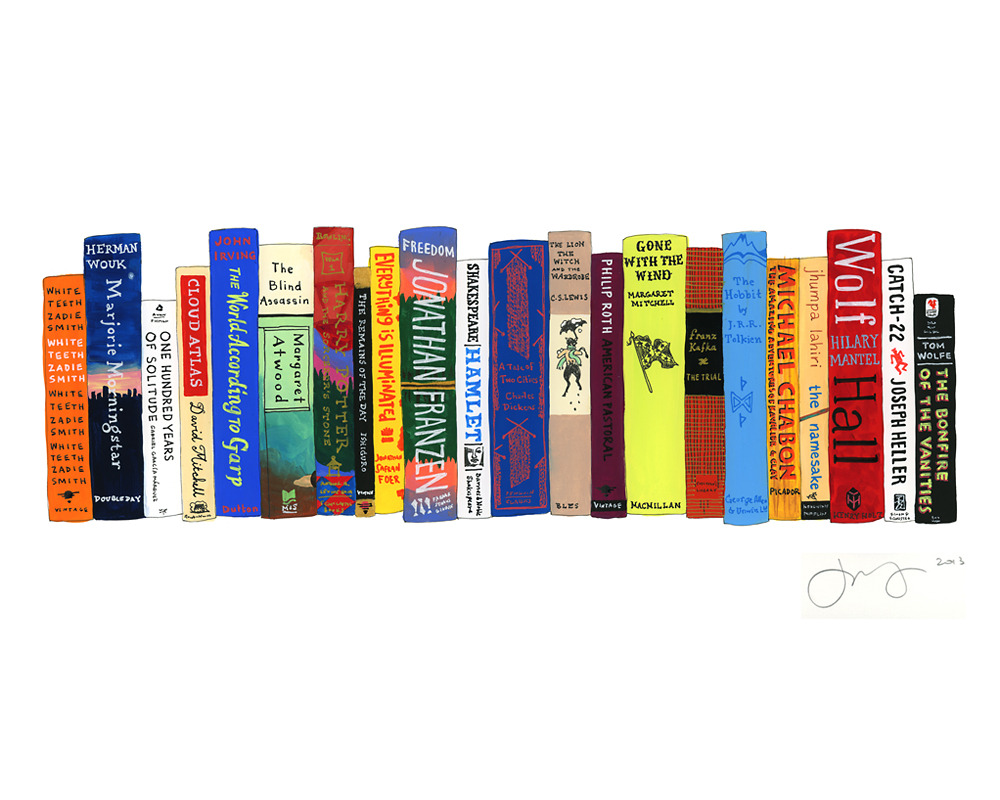
Also, I love the paintings of people's bookshelves in Jane Mount's book - I keep thinking about what would be on my idea bookshelf.  Maybe at some point I'll have to actually design one and draw it out.


photo credit: idealbookshelf by Jane Mount

November 10, 2012

A New Hope


Obama

Some articles that have caught my eye in the news after the election:

*Apparently being against reproductive choices for rape victims makes you un-electable.  Thank goodness.

*A comment from Friedman on why Obama won - and why the Republicans in Congress need a change of heart (and maybe they are, thank you Boehner?)  Best quote:  "Many in the next generation of America know that climate change is real and they want to see something done to mitigate it.  Many in the next generation of America will be of Hispanic origin and insist on humane immigration reform that gives a practical legal pathway to citizenship for illegal immigrants...Many in the next generation of America see gays and lesbians in their families, workplaces, and Army barracks and they don't want to deny them marriage rights held by others.  The GOP is at war with too many in the next generation on all these issues."  I would add to this reproductive choice - which was a clearly decisive factor in voting for many women (and men!)

*20 quotes on immigration from politicians including Rep. Steve King (R-Iowa), "Obama voters chose dependency over Liberty.  Now establishment R's want citizenship for illegals.  You can't beat Santa Claus with amnesty"  Wow.  I'm not even sure what he means by that, but it does not sound either nice or productive.

*A surprise victory in Minnesota for gay marriage rights - where the campaign manager of Minnnesotans United for All Families (around 1:45am) is thanking everyone and telling them to go get some sleep because the results likely won't be in for a while....and then they get a result.  It was the first time in US history than anti-gay marriage constitutional amendment had been defeated.

October 24, 2012

Choosing What We Show

Recently, I interacted with a woman around my age who had come to the clinic where I was working with the intention of terminating her pregnancy.  It's been so long I can't remember how many weeks along she was, but not far.  Women enter these difficult and emotionally wrought visits with a clinician in all styles.  Some openly weep, some list all the reasons why this is the right decision - as if convincing themselves, some are silent and refuse to make eye contact, many are curious - about the pregnancy, about their options, about what they might see or not see, how their lives may be different depending on how they choose.

I feel so lucky to live in a country, in a time, when women get to make these decisions - though saddened that their decisions were not instead the less emotionally draining one of choosing effective birth control or choosing not to have sex in the first place.  I feel even more lucky to have worked in a clinic that allowed women the space to feel, think, and process whatever they needed.

This woman, let's call her Sarah* (*obviously not her real name), knew she was pregnant but was not sure how many weeks - so we did an abdominal (on the belly) ultrasound to take measurements to date her pregnancy.  There has been a good deal research on interactions with ultrasound technicians by women considering termination and the data is surprising.  But first, because ultrasound is a tricky subject these days, let me set the facts straight: everyone who is seeking or considering a termination usually has an ultrasound to date the pregnancy, because this determines many things about the possible procedures and counseling.  In the vast majority of cases, this ultrasound is done abdominally (on the belly) and is only done transvaginally (in the vagina) if the pregnancy is too early, and therefore the uterus too low in the pelvis and too small to see through the abdomen.  There are some people trying to pass laws about ultrasound and pregnancy termination that require very different things, including transvaginal ultrasounds, narration of ultrasounds, listening to heart beats, seeing moving images, etc.  This has not been my experience.  

In research investigating how to interact with a woman considering termination when conducting an abdominal (on the belly) ultrasound, the results are surprising in that many women are interested in seeing the image, many would even like an image printed to take home.  Even more fascinating is that there does not seem to be a pattern with the choices women make (in terms of keeping the pregnancy or terminating the pregnancy).  Additionally, when ultrasonographers (the people who do the ultrasounds) and clinicians are interviewed, they largely believe that women should not see the ultrasound if they are considering or have decided to terminate a pregnancy.  There are still many questions to be answered - including if the age of gestation matters (many of these papers were only involving women who were intending to have first trimester terminations), larger sample sizes, longer term effects, correlation with other factors such as parity and reasons for termination.

Planned Parenthood has a national policy where every woman is asked, before stepping into the ultrasound room, if she would like to know if she has more than one pregnancy (twins, triplets, etc), and if she would like to see any images.  Anecdotally, I have been told that most other clinics don't ask and do not offer unless the woman asks explicitly to see a picture.  

As I have had more experience with this, and after hearing an amazing presentation on some soon to be published data on women's experiences of ultrasound before a termination, I decided that I am going to ask women if there is anything they would like to see or not see, know or not know.  And I have been fascinated by the results.  

Which brings me back - finally - to Sarah*.  Sarah was very quiet when I brought her to the ultrsound room.  I had already asked Sarah the same question I ask everyone and she had said she would like to see an image.  Again, based on experience, the teaching I have received, and the data I have seen, whenever I show anyone an image, I zoom out so that there's slightly more realistic perspective of the size of the pregnancy, and I point out the abdominal wall, the uterus, and the pregnancy, as well as any other obvious structures.  When I did this for Sarah, she started crying.  In my desire to comfort her, I quickly turned the ultrasound away from her and sat in a chair next to her.  I asked her what was going on her in head at that moment, and if there was anything I could help with.  When she shook her head No, I put my hand on her back and reminded her that the next step at our clinic is to talk in depth with a counselor.  I asked her if she wanted to see any other images, and when she said No, I walked with her to the counselor's office, where the three of us sat and talked for a long time.

To be continued in the next post, as it takes this thought in a slightly different direction.

~~~~~~~~~~~~~~~~~~~~~~~~~~~~~~~~~~~~~~

"I pointed out that she was, by definition, pro-choice.  In its simplest form all it means is that the woman gets to decide".
-Susan Wicklund, Physician and Author of This Common Secret
(click the link to see a NYT review of her book)

September 4, 2012

choices

oh hey there.  yup, I know I've been away from my blog a while.  (It's been a pretty busy summer!)  But while studying at the beach, hiking around Yosemite, and spending 15 hour days at the hospital on my cardiology rotation (more on those soon) - I've been thinking about the goals of my blog.  It has and will always be a space where I record down the most interesting thoughts that have come up in the conversations all around me.  However, clearly (hopefully!) there are just way too many fascinating questions and thoughts to record them all down - I'd be sitting at my computer typing all day, instead of having interesting discussions!  So I'm going to try to commit to a goal of putting up at least one blogpost a week, and if that feels good, I may expand to 2.  Then I can at least keep track of some of the interesting thoughts that have come up in the past week.  I'd like to do this in a way that lets you know when to expect a new post and also keeps me honest - so I'm planning on a "by Monday evening" weekly posting.  Except for this week ofcourse, because Monday was really second Sunday :)

Maybe because I'm creating my residency application list (due in less than a month!) but I've been thinking a lot about CHOICES lately, as in - how do we make them? Are we even good at making them?  What makes a good choice?  What are the hardest choices we have to make?  What should be the easiest?  So while I construct a post or two about my crazy fascinating month of Cardiology, hopefully these thoughts will get you thinking too:

*An Amazing Book About Choice (called Choice: True Stories) recommended by a dear friend.  It's a collection of essays by women about their choices surrounding reproduction.  Everything from adoption to what it meant to finally be a mother to abortion to miscarriage to raising a daughter.  The authors are lots of famous writers too, so it's beautifully written, and most of all, a great reminder of the impact of these choices, and that how they are made can change the experience entirely.

*I also read a fascinating article (called "The Two-Minus One Pregnancy") about twin reduction (if you're intrigued and/or confused, you should read the article) in the NYT sent to me by another friend.  This friend is going to do a presentation on this to our journal club and I'm really intrigued.  It's definitely a topic that makes me really uncomfortable, as it challenges where the edge of my morals lies.

*I also watched a TedTalk by Sheena Iyengar, who is a researcher at Columbia whose interest is in Choices, how we make them, if we are good at them, etc.  One my favorite examples is when she talks about some of her experiments - including one where she interviews people from post-communist Eastern European countries and offers them an option of seven different sodas.  They all say, this is only really two options: soda or no soda.  Despite the fact that in the US, some of us get angry if we are given a Coke instead of a Pepsi or vice versa.  I'm excited to read more about her.

That's all for now!   But I'm back and more is coming (check back on Monday evening or Tuesday mornings)!

e

~~~~~~~~~~~~~~~~~~~~~~~~~~~~~~~~
"It is our choices that show who we really are...far more than our abilities"
- Dumbledore
(in JK Rowlings Harry Potter and the Chamber of Secrets)

March 19, 2012

choice


All the battles over contraception coverage that have older men inappropriately talking about the reasons women use contraception, as well as the heated debates about new laws that humiliate and isolate women while they are making these very difficult decisions.
A recent study from the Guttmacher Institute showed that HALF of all reproductive age women now live in states that are hostile to abortion!  This map below shows the change over time in states hostility to policies related to contraception and terminations. 
It may also be a map of where I am applying to residencies next year.


Shrinking Middle Ground

and just in case you haven't been following along - Doonesbury is running a series on the new laws surrounding a woman's right to make reproductive decisions that is obviously now being censored.  Check out the censored strips on Slate blog.

October 13, 2011

getting stuck

today I was first assist on a below-the-knee amputation on an older man with diabetes.  It's a pretty brutal operation - as in, they actually use an actual bone saw, a very large knife and it's less possible than I thought it would be to precisely cut off the muscle in someone's leg.
But somehow I do have the stomach for surgery -  so even though at moments it seemed like a halloween trick gone awry,  I was able to focus on how fascinating it was to identify and technically interesting it was to  isolate the three major neurovascular bundles in the leg (sort of like tubes containing nerves and the blood vessels that supply them).


the attending sutured the muscle/fascia layer because that is the critical layer for holding the operation together
but then he let me suture half of the skin line.
I've just started feeling more confident in my suturing and yesterday I got to suture a lot, 
so I was feeling almost confident


until I stuck my own finger with the needle.


this is not an uncommon thing in medicine
in fact, the first thing that happened was that the scrub tech, the circulating nurse, and my attending all empathized with me and told me how many times they had been stuck

then they told me to take off my gloves and gown and go wash my hand with bleach
I was escorted from the OR to another building in the hospital to start the "needle stick protocol".
this consisted of me walking into the employee health center and being immediately ushered into a small room (they were expecting me because the OR had already called them), filling out a report about what happened, hearing what would happen from there on out:


1. The patient would be told that one of the health care workers in his surgery had been exposed to his blood, would he consent to be tested for HIV, HepC, and HepB please?  (he said yes) Would he please fill out a survey outlining his risk factors? (his wife did, he was still waking up from anesthesia)
2. I would fill out these incident reports.  One would be filed with employee health and one I would take to my supervisor.  Because I'm a med student and don't have a medical health record number, I would also have to create one of those.
3. I would have to have five tubes of blood drawn from the lab downstairs, now.
4. the nurse on call tonight would call me back with the results of the patient's STAT HIV test.
5. they would call me tomorrow with the results of his other tests and by Monday with the results of my tests
6. if I had any questions, I could call them.  If the tests were negative there was nothing else to do. If they were positive - well, there are more tests.
So I did.

I am really really lucky.
Less than two hours later, they called me with his previous lab results (all negative), and his risk factors ( blood transfusions in the hospital only - very unlikely to contain HepC or HIV), and later this afternoon called me with the results of his STAT HIV test - negative.
The nurse on the phone told me that I could breathe a big sigh of relief -
but that she'd still call me with all the rest of the test results.

Talking on the phone with the manfriend, he sounded almost more worried than I was, realizing for the first time that if we are both going to be doctors we are going to be at greater risk of contracting some pretty serious diseases.  And maybe more importantly, how will we organize our careers around this - will we try not treat people with more easily contractable incurable illnesses like HIV/AIDS? (hopefully we will treat them just the same as anyone else)  Will we wear more layers of gloves?  Will we be better about getting vaccines?  Get serum tests for transmissible diseases every year?  Or maybe just try hard not to think about it too much and carry on with what we've decided are our respective callings?

This article caught my eye because it explains some of the very scary things that can happen to med students, and yet is still very inspiring.  I'm reading Abraham Verghese's In My Own Country right now, which is about his own experience treating the first patients with HIV and it's making me think a lot about the balance between protecting yourself and providing good medical care.

~~~~~~~~~~~~~~~~~~~
"But we also agreed that what made the difference in life was not how well you succeeded;  it was how well you failed, how many times you picked yourself up
and put yourself back in the fray."
- Dr. Dietrich 
who contracted HepC from a needle stick as a third year medical student, 
see the article above

October 6, 2011

Surgery at the End of Life

I've been thinking a lot this week about how strange it is that so many people are choosing such serious interventions for medical problems that are likely to not be their cause of death.  Don't get me wrong, we can do really amazing things with surgery and interventions now that save lots of lives and maybe even more importantly, improve the quality of life for so many people.  But it still seems like mostly, surgery should be an option of last resort.  Maybe this is more striking because I'm seeing all the patients in the ICU and in the hospital after surgery and recovery can be such a brutal process that it seems like, especially at an older age, surgery would be something you would want to avoid unless it was going to really make a difference in either the quality or quantity (or both) of years in your life.
Sometimes I wonder how much of it is just us not wanting to NOT be able to do something.  Like I said at the beginning of this surgery rotation, the really good surgeons are the ones who know when NOT to operate.

Check out this interesting article in the Times about how common surgery is at the end of life.

Dr. Jha provided a recent example from his hospital. A man had metastatic pancreatic cancer and was dying. A month earlier, he had been working and looked fine. “No one had talked to him about how close he was to death,” Dr. Jha said. “It’s the worst kind of conversation to have.” Instead, doctors did an endoscopy and a colonoscopy because the man had internal bleeding. Then they did abdominal surgery. “We did all of this because we were trying desperately to find something we could fix,” Dr. Jha said.
The man died of a complication from the surgery.
“The tragedy is what we should have done for him but didn’t,” Dr. Jha said. “We should have given him time to have the conversation he wanted to have with his family. You can’t do that when you are in pain from surgery, groggy from anesthesia. We should have controlled his pain. We should have controlled his nausea." Instead, Dr. Jha said, “we sent him to the O.R.”

October 5, 2011

Stay Hungry Stay Foolish


An extraordinary individual who changed the way we see the world and each other.

"your time is limited, so don't waste it living someone else's life. Don't be trapped by dogma - which is living with the results of other people's thinking.  Don't let the noise of others' opinions drown out your own inner voice.  And most important, have the courage to follow your heart and intuition.  They somehow already know what you truly want to become.  Everything else is secondary."


September 27, 2011

focus on the fraud

just a quick little post to tell you about an op-ed in the NYT about how medicaid and medicare (not to mention all of us taxpayers who pay for these programs) are swindled out of billions of dollars each year because of health insurance fraud.  this editorial calls for the US and state governments to crack down on these false claims, securing the collapsing system from at least one side.  I like it.

from the article:

But before charging consumers more and eliminating valuable services, we should be much more aggressive in recovering money stolen from these taxpayer-supported programs. According to some estimates, health care fraud is a $250 billion-a-year industry, and about $100 billion of that is stolen from Medicare, the health care program for the elderly, and Medicaid, the insurance program for the poor and disabled.
There are many ways to defraud taxpayers. For example, a hospital chain can buy drugs at a steep discount and then bill Medicare for high sticker prices. Doctors can bill for procedures that never happened, or for drugs that were supplied to them by pharmaceutical companies free of charge, or pharmaceutical companies can promote a drug for risky, unapproved uses.
Recovering billions of dollars from these ruses won’t solve the problem of rising health care costs, but it’ll go a long way in helping to reduce waste and protect services.

September 24, 2011

Trick Yourself Into Faster, Higher, Better ?


If I put you on a stationary bike in front of a video game screen with an avatar riding a bike and told you that the avatar would be going at your own personal best pace - would you try stay with it?  Would you beat it?  What if that avatar was actually riding a bit faster than your best pace, but I didn't tell you?  Do you think you'd still beat it?

A recent article sent to me by a good friend says that if the avatar is only going 2% faster than your best - you will beat it. It talks about research being done to show that we can actually trick ourselves to be faster and push harder than we ever have before - which is sort of what we do in races and competitions.  As a self-proclaimed runner who is always recruiting new runners (!!) I tell people that one of the hardest parts of running - especially marathon training - is getting used to the idea that you don't have to stop when your mind or body says you should.  Once you do this just one time - keep running after your body/mind has told you to stop - it's incredibly freeing because you realize that you are more powerful than your thoughts or signals.  But sometimes this motivation involves playing tricks on your mind like, I am going to run as hard as I can because maybe I'll rest at the top of this hill.  Then when you get to the top of the hill, picking a new place you're going to "stop".  These mind tricks are also how in competition we make ourselves go faster - not "I need to go faster than I previously have" but "I need to beat that person".

The experiments explained in this article are fascinating and makes me wonder what sorts of mind tricks I'm playing on myself - not only in my life as an athlete (which maybe more consists of tricking myself into running at all), but also as a medical student.  I find myself picking out the narratives that keep me motivated all the time.

From the article:
In their laboratory, Dr. Thompson and his assistant Mark Stone had had the cyclists pedal as hard as they could on a stationary bicycle for the equivalent of 4,000 meters, about 2.5 miles. After they had done this on several occasions, the cyclists thought they knew what their limits were.
Then Dr. Thompson asked the cyclists to race against an avatar, a figure of a cyclist on a computer screen in front them. Each rider was shown two avatars. One was himself, moving along a virtual course at the rate he was actually pedaling the stationary bicycle. The other figure was moving at the pace of the cyclist’s own best effort — or so the cyclists were told.  In fact, the second avatar was programmed to ride faster than the cyclist ever had — using 2 percent more power, which translates into a 1 percent increase in speed.  Told to race against what they thought was their own best time, the cyclists ended up matching their avatars on their virtual rides, going significantly faster than they ever had gone before.
~~~~~~~~~~~~~~
"Work It Harder Make it Better
Do It Faster, Makes Us Stronger
More than Ever Hour After
Our Work is Never Over"
-Daft Punk lyrics to Harder, Better, Faster, Stronger
(such a good workout song)

June 21, 2011

Elastic Doctor Women


an anesthesiologist recently wrote an op-ed about women in medicine where she discusses how the personal decisions made (mostly by women, she says) about having children should be taken into account when we're deciding who to admit to medical school and residency programs.

And I quote:

"I have great respect for stay-at-home parents, and I think it’s fine if journalists or chefs or lawyers choose to work part time or quit their jobs altogether. But it’s different for doctors. Someone needs to take care of the patients."

"Students who aspire to go to medical school should think about the consequences if they decide to work part time or leave clinical medicine. It’s fair to ask them — women especially — to consider the conflicting demands that medicine and parenthood make before they accept (and deny to others) sought-after positions in medical school and residency. They must understand that medical education is a privilege, not an entitlement, and it confers a real moral obligation to serve."

I'm not quite sure what to say first.
Luckily, other people responded faster and I got to read some eloquent Letters to the Editor.

One, from a neurosurgeon who said that this had long needed to be said, that maybe you could be a part time pediatrician and be okay, but any part time surgeon would be inferior because her skills would be worse.

Another, from a family med doctor who said that she thought it was interesting that an anesthesiologist - who walks away at the end of the day without any patients, whose patients are asleep for 90% of the time she sees them - would be able to comment on what constitutes "full-time". Spending 30-35 hrs/wk face-to-face with patients grappling with all sorts of diagnostic dilemmas certainly is different than 40hrs/week of unconscious patients who never call you at 2am.

One of my favorites was from a doctor who wondered why the author wanted to ask prospective med students about working part time and not if they wanted to subspecialize, or if they wanted to do academic medicine or work for a pharmaceutical company... or all the other ways doctors practice that is not filling our major needs for doctors.
***
At this point in my career, those decisions about family and lifestyle seem to be closer and more real than ever before and I do feel a strong pull towards the honor and responsibility of practicing medicine, of being someone's doctor. So I'm doing a lot of adjusting of my vision of being a mom, of being a wife, of being a neighbor, a sister, a cousin, an aunt, a dog owner...

but don't we want our doctors to be all those things too?
we don't want to create these doctors who live in the vacuum of a hospital, where they don't interact with anyone without asking them how they'd rate their pain on a scale of 1 to 10, do we? we want doctors to understand the importance of parents, of siblings, of partners, of children. how can we expect doctors to understand how we value these people without expecting them to value them also?
I'm still not sure how I will be all these things at once, and it certainly hasn't been easy to be a med student and all these things, but I'm going to keep trying.

(in case you don't know, that's Elastigirl, a pixxar character from the Incredibles,
designed to be able to to everything at once - the perfect mom)


May 29, 2011

Why Medical School Should Be Free

I have to post this whole article from the NYT because I have only one comment: YES! YES! YES! the system should not be set up to herd us into fields like dermatology and radiology (no offense to those fields at all) because they have nicer hours of work. We need dermatologists and radiologists, but not as many as family medicine doctors, pediatricians, internists, palliative care specialists, etc. let us medical students (who hopefully all went to medical school because we want to gain the knowledge and skills to help keep people healthy) choose what we want to do based on what we're good at and what we're interested in - and have to weigh that against what the country (world?) needs, instead of against our huuuuge loans. YES YES YES to this plan.


Why Medical School Should Be Free

By PETER B. BACH and ROBERT KOCHER

DOCTORS are among the most richly rewarded professionals in the country. The Bureau of Labor Statistics reports that of the 15 highest-paid professions in the United States, all but two are in medicine or dentistry.

Why, then, are we proposing to make medical school free?

Huge medical school debts — doctors now graduate owing more than $155,000 on average, and 86 percent have some debt — are why so many doctors shun primary care in favor of highly paid specialties, where there are incentives to give expensive treatments and order expensive tests, an important driver of rising health care costs.

Fixing our health care system will be impossible without a larger pool of competent primary care doctors who can make sure specialists work together in the treatment of their patients — not in isolation, as they often do today — and keep track of patients as they move among settings like private residences, hospitals and nursing homes. Moreover, our population is growing and aging; the American Academy of Family Physicians has estimated a shortfall of 40,000 primary care doctors by 2020. Given the years it takes to train a doctor, we need to start now.

Making medical school free would relieve doctors of the burden of student debt and gradually shift the work force away from specialties and toward primary care. It would also attract college graduates who are discouraged from going to medical school by the costly tuition.

We estimate that we can make medical school free for roughly $2.5 billion per year — about one-thousandth of what we spend on health care in the United States each year. What’s more, we can offset most if not all of the cost of medical school without the government’s help by charging doctors for specialty training.

Under today’s system, all medical students have to pay for their training, whether they plan to become pediatricians or neurosurgeons. They are then paid salaries during the crucial years of internship and residency that turn them into competent doctors. If they decide to extend their years of training to become specialists, they receive a stipend during those years, too.

But under our plan, medical school tuition, which averages $38,000 per year, would be waived. Doctors choosing training in primary care, whether they plan to go on later to specialize or not, would continue to receive the stipends they receive today. But those who want to get specialty training would have to forgo much or all of their stipends, $50,000 on average. Because there are nearly as many doctors enrolled in specialty training in the United States (about 66,000) as there are students in United States medical schools (about 67,000), the forgone stipends would cover all the tuition costs.

While this may seem like a lot to ask of future specialists, these same doctors will have paid nothing for medical school and, through their specialty training, would be virtually assured highly lucrative jobs. Today’s specialists earn a median of $325,000 per year by one estimate, 70 percent more than the $190,000 that a primary care doctor makes. (Although a large shift away from specialty training may weaken the ability of our plan to remain self-financed, the benefits would make any needed tuition subsidies well worth it.)

Our proposal is not the first to attempt to shift doctors toward primary care, but it’s the most ambitious. The National Health Service Corps helps doctors repay their loans in exchange for a commitment to work in an underserved area, but few doctors sign up. The National Institutes of Health offers a similar program to promote work in research and public health, but this creates more researchers, not more practitioners.

Many states have loan forgiveness programs for doctors entering primary care. The health care reform law contains incentive programs that will include bonuses for primary care doctors who treat Medicare patients, and help finance a small increase in primary care training positions.

Our proposal is certain to raise objections. Because some hospitals that provide training to specialists are not associated with medical schools, we will need a system to redistribute the specialty training fees and medical school subsidies. Several entities that have not collaborated before, including the organizations that license specialty training programs and medical school associations, would have to work together to manage this. For the plan to work, it will also be critical that medical schools do not start raising tuitions just because people other than their students are footing the bill.

Our plan would not directly address the chronic wage gap between primary care providers and specialists. But efforts to equalize incomes have been stymied for decades by specialists, who have kept payment rates for procedures higher than those for primary care services. When Medicare has stepped in, most of the increases given to primary care have been diluted by byzantine budgetary rules that cap total spending.

Nothing in our plan would diminish the quality of medical school education. If anything, free tuition would increase the quality of the applicants. Neither would our approach quash the creativity of medical schools in developing curriculums. Medical students would still be required to pass the various licensing examinations and complete patient care rotations as they are today.

Critics might object to providing free medical education when students have to pay for most other types of advanced training. But the process of training doctors is unlike any other, and much of the costs are already borne by others. Hospitals that house medical residents and specialist trainees receive payments from the taxpayer, through Medicare. Patients give of their time and of their bodies in our nation’s teaching hospitals so that doctors in training can become skilled practitioners.

We need a better way of paying for medical training, to address the looming shortage of primary care doctors and to better match the costs of specialty training to the income it delivers. Taking the counterintuitive step of making medical education free, while charging those doctors who want to gain specialty training, is a straightforward way of achieving both goals.

Peter B. Bach, a senior adviser at the Centers for Medicare and Medicaid Services from 2005 to 2006, is the director of the Center for Health Policy and Outcomes at Memorial Sloan-Kettering Cancer Center. Robert Kocher, a special assistant to President Obama on health care and economic policy from 2009 to 2010, is a guest scholar at the Brookings Institution. They are both doctors.


May 22, 2011

public health and zombies

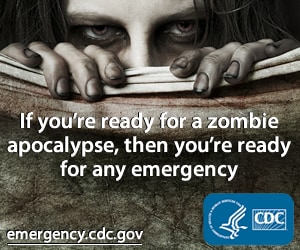
If you're ready for a zombie apocalypse, then you're ready for any emergency. emergency.cdc.gov

I learned a few things this week about the CDC's Public Health campaign in a NYT article this morning that I want to share with you:

(1) the CDC just published a report on the 10 great public health achievements in the first decade of the 2000s (2001-2010) that includes better tobacco regulations, better vaccine availability, improved maternal and fetal health, motor vehicle accidents, lead poisoning, occupational health, and public health preparedness and response.

(2) there is no current budget increase for the CDC proposed for next year, and the CDC is categorized as "discretionary domestic spending", a part of the budget being attacked by Republicans attempt to slash public spending. "The budget was slashed 11% in fiscal year 2011, putting it among the hardest-hit government agencies, with significant cuts for emergency preparedness. Public health preparedness dollars have been cut more than 30% since 2005."

(3) this past Monday, the CDC came out with a zombie apocolypse preparation guide on their Public Health Matters blog, with advise on how to prepare for a zombie invasion. Seriously. And it's obviously under the category of Emergency Preparedness and Response.
And now they're holding a video contest for anyone who can show in 60 seconds how they're preparing for any emergency (hurricanes, earthquakes, tsunamis, zombie apocalypses).

What a call to the nation about public health - the CDC's public health blog usually gets about 1,000 hits a day has already gotten over a million. It makes me happy that the CDC is getting more accessible. I might actually start reading the public health blog even when it's not about zombies :)

~~~~~~~~~~~~~
"It is a truth universally acknowledged that a zombie
in possession of brains must be in want of more brains."
(and)
"No ninjas! How was that possible? Five daughters brought up at home without any ninjas! I never heard of such a thing. Your mother must have been quite a slave to your safety."

- Seth Grahame-Smith,
Pride and Prejudice and Zombies
book review soon?


April 22, 2011

Book Review: Every Patient Tells A Story


Q: What book have you read lately that feels really relevant?

A:
I have two actually - one is Zeitoun, by Dave Eggers, which tells a story about one family's experience with Hurricaine Katrina, the disaster that was the response to it, and the prejudice against Islamic Americans in the aftermath of 9/11. Until I read Dave Eggers narrative, I don't think I truly grasped just how horrible the US's response to Hurricaine Katrina was. I recommend it highly - it's beautifully written and super easy to read.

The other is maybe more relevant to what I'm learning about right now - "Every Patient Tells A Story" by Lisa Sanders, MD, a columnist for the NYT who was a journalist before going to medical school and is the current medical advisor for the show House, MD. The book is filled with all the puzzles of the cases in her column and on House, but also with some lessons in what skills good doctors have to approach these puzzles. The first lesson, maybe unsurprisingly given everything I've written about on this blog (or just the title of her book), is that really good doctors LISTEN TO THE PATIENT'S STORY.
I'm about to begin my clerkship rotation in Family Medicine, which besides strictly diagnostic fields like Pathology and Radiology, is the division of medicine that does the most problem solving - and unlike Radiology and Pathology - it's reading the PATIENT, not his tissue sample or X-rays. Dr. Sanders' book is awesome in that it's fascinating, but also because it reminds us that being doctors is not so unlike being detectives - that not only do you have to know what the clues mean, but you have to actually notice they're there in the first place.
In her intro, Dr. Sanders says that studies have found that Doctors interrupt patients in the first 11 seconds of their story, and that if they waited, they might get a whole lot more information. My goal for my family medicine rotation is to not interrupt my patients to ask questions unless it's absolutely necessary (still have to stick to some time limits)

~~~~~~~~~~~~~~~~~~
"...It [diagnosing a sick patient] is a wayward process
filled with unreliable narratrators - both human and technological -
and yet, despite the unlikeliness,
that answer is often reached and lives are saved"
-Lisa Sanders, MD

April 12, 2011

Children After 30


According to new research, older parents are happier than younger parents. It seems that before the age of 30, parents with children are less happy than people without children. However, by age 40, the trend shifts so that people with children are happier. Additionally, the researchers found that this varied a lot by culture - in cultures where most support later in life depends on family, people had more positive associations between children and happiness, whereas in cultures where most support is public, children and happiness were less closely associated.

Interesting stuff, huh? I think this is a little bit like finding research that supports chocolate as being good for your health - it just makes sense to me. There's so much to do in your 20s that having kids could prevent you from getting to enjoy as thoroughly, whereas having children, cultivating a family and a life focused on that family is a huge part, culturally in the US, of our late 30s/early 40s.


~~~~~~~~~~~~~~~~~~

Come, my love
we have mountains to climb
wilderness to wander
-Saul Williams

April 10, 2011

babies going through withdrawal?

From an article in the NYT today about babies who were exposed to opiates in utero and the intense withdrawal they go through when pregnant women try to quit "cold turkey" - seems incredibly relevant given all the opiate addictions I saw in Florida.

stay tuned for a top ten list of things I learned during my psych rotation!


“Most of the literature suggests consistently that the drug exposure itself is not the primary concern,” ...“It’s the cumulative effect of the drug-using lifestyle — poverty, chaos in the home, domestic violence. All those things affect development.”

Not all newborns exposed to opiates have severe enough withdrawal to need medicine; at Maine Medical Center since 2003, about 55 percent of babies exposed to buprenorphine and 80 percent of those exposed to methadone have needed treatment. But it is hard to predict which ones will need it: a newborn whose mother was on a high dose of either drug might need none, while a baby whose mother took a low dose might experience acute withdrawal.

April 8, 2011

The Ryan Plan for Medicare AKA: break it.

In an extremely well-written editorial yesterday, Paul Krugman explains why Representative Ryan and the Republicans overhaul of Medicaid to save money is not just ludicrous, but cruel (actually that's the title of his editorial).

In short, it would switch Medicare funding to private insurers which would INCREASE the cost initially by adding middlepeople (hence, ludicrous).

AND it would create Medicaid vouchers that people could use to pay for care that the Congressional Budget Office estimates would only pay for less than 1/3 of the cost of private insurance by 2030, leaving many if not most older Americans unable to afford medical care (hence, cruel).

With all the health care reform underway, and all the criticism of the Obama Administration's overhaul of our medical system, no one has been ridiculous enough to suggest that we stop paying for health care for older people in order to make the system affordable.

Well, until Rep. Ryan got involved. Yikes.
Krugman adds, "as the Center on Budget and Policy Priorities points out, of the $4 trillion in spending cuts [Ryan] proposes over the next decade, two-thirds involve cutting programs that mainly serve low-income Americans. And by repealing last year’s health reform, without any replacement, the plan would also deprive an estimated 34 million nonelderly Americans of health insurance."

If you're interested in more views on the Medicare debate, check out this great article in the Atlantic: Undoing Medicare: The Real Death Tax


~~~~~~~~~~~~
"the pundits who praised this proposal when it was released were punked. The G.O.P. budget plan isn’t a good-faith effort to put America’s fiscal house in order; it’s voodoo economics, with an extra dose of fantasy, and a large helping of mean-spiritedness"
-Paul Krugman 


April 3, 2011

International Medical Service Corps


A NYT article this weekend discusses some of the stories of physicians working in other countries. More physicians (and new graduates from medical school!) are interested in working abroad than ever before; this makes sense, as our world becomes more and more connected, refugees from poorer, war-torn countries have entered all of our lives, and we read every day about other countries falling apart (for now, I won't mention the ways in which our own is falling right with them...)

However, the way this is financed is incredibly scattered and often involves a component of financial support from the individual, which is not always feasible to medical graduates who are carrying many hundred thousands of dollars of debt. Vanessa Kerry MD (John Kerry's daughter), and Paul Farmer MD wrote an editorial in the New England Journal of Medicine, arguably medicine's most prestigious and well-read journal, advocating for the creating of a Peace Corps-like Medical Corps of new graduates and health professionals who would work with and train medical personnel in some of the poorest countries around the world. They argue that this would foster improvement in these countries economies - because they would have to spend less on the costs of pandemics - as well as foster better international relations.

This is something I hope to do after I graduate, but I won't be able to if I have to pay back my loans on the salary I make after residency. Therefore, I am very interested in these programs becoming more financially feasible.

~~~~~~~~~~~~~~~~~~~~
"She plans to deliver in the same place she gave birth before – in her cow shed. When women are menstruating or giving birth, they are considered to be ritually polluted and must stay outside of the home, often in cowsheds or cement rooms near toilet facilities."
-Gates Foundation Website about a Nepali patient

April 2, 2011

What Makes the ER Attractive

In case you are one of the four people who has not read it yet - the NYT had an article this morning called "More Physicians say No to Endless Work Days" about how physicians are shifting their career choices more towards ER and hospitalist jobs, where they care for patients in the hospital, but when they leave the hospital, their obligations to their patients leave with them. This is attractive as a lifestyle because it allows time with ones family to be sacred, instead of interrupted by phone calls about their patients.

I'm had a bunch of conversations about this exact topic with friends lately and I can say it is very true. I think about a third of the fourth year class at my medical school matched to ER residencies - one third (of about 100 people)! At dinner last night, Chris and I were talking about the pros and cons of being this type of doctor. You see your patients get better immediately, but a lot of them never get better, and the goal is really to just stabilize them until you can transfer their care to someone else. The ER doctor is the "jack of all trades" - broad knowledge, but not deep. A lot of this is incredibly appealing now when we all want to know and do everything, but I still can't shake the feeling that I want to have relationships with my patients. Not necessarily relationships that often trump those that I have with my friends and family, but maybe sometimes?

here's a quote from the article, which you should totally check out and let me know what you think!

“Look, I’m as committed to being a doctor as anyone. I went back to work six weeks after my boys were born. I love my job,” said Dr. Kate Dewar. “But I was in tears walking out of the house that first day. I’m the mother of twins, and I want to be there to feed them, play games with them or open presents with them on Christmas morning. Or at least I want the option to do those things without fearing I’ll be called back to the hospital.”